Author Scam Alert
⚠️ SCAM ALERT
The South Coast Writers Centre has been made aware that someone is sending targeted emails to writers, both in Australia and overseas, impersonating the South Coast Readers & Writers Festival.
The scammer emails authors from various Gmail addresses — including southcoastreadersandwritersfes@gmail.com and southcoastwritesfestival@gmail.com — praising their book, inviting them to take part "virtually," then asking for a "registration fee" and payment for "book showcase" options. These emails fraudulently misuse the name of a real member of our team, who has nothing to do with them.
This is not us. Our only genuine emails end in @southcoastwriters.org. While we do run some paid author programs, applications and payments go through our website and secure payment system — we never ask you to pay, or share credit card details, by email. Please don't reply, pay, or return any form to southcoastreadersandwritersfes@gmail.com, southcoastwritesfestival@gmail.com, or any similar fraudulent Gmail address.
Scams Targeting Authors and How to Avoid Them
Scams targeting authors are becoming more prevalent and convincing. With the rise of generative AI, it’s becoming harder to identify scams, meaning authors are even more at risk to falling victim.
With the touch of a button, AI allows scammers to appear more believable and targeted. This is because AI tools can utilise words and phrases from any reviews, comments, blurbs, and interviews published online, allowing scammers to appear as though they are real people who have actually read your book.
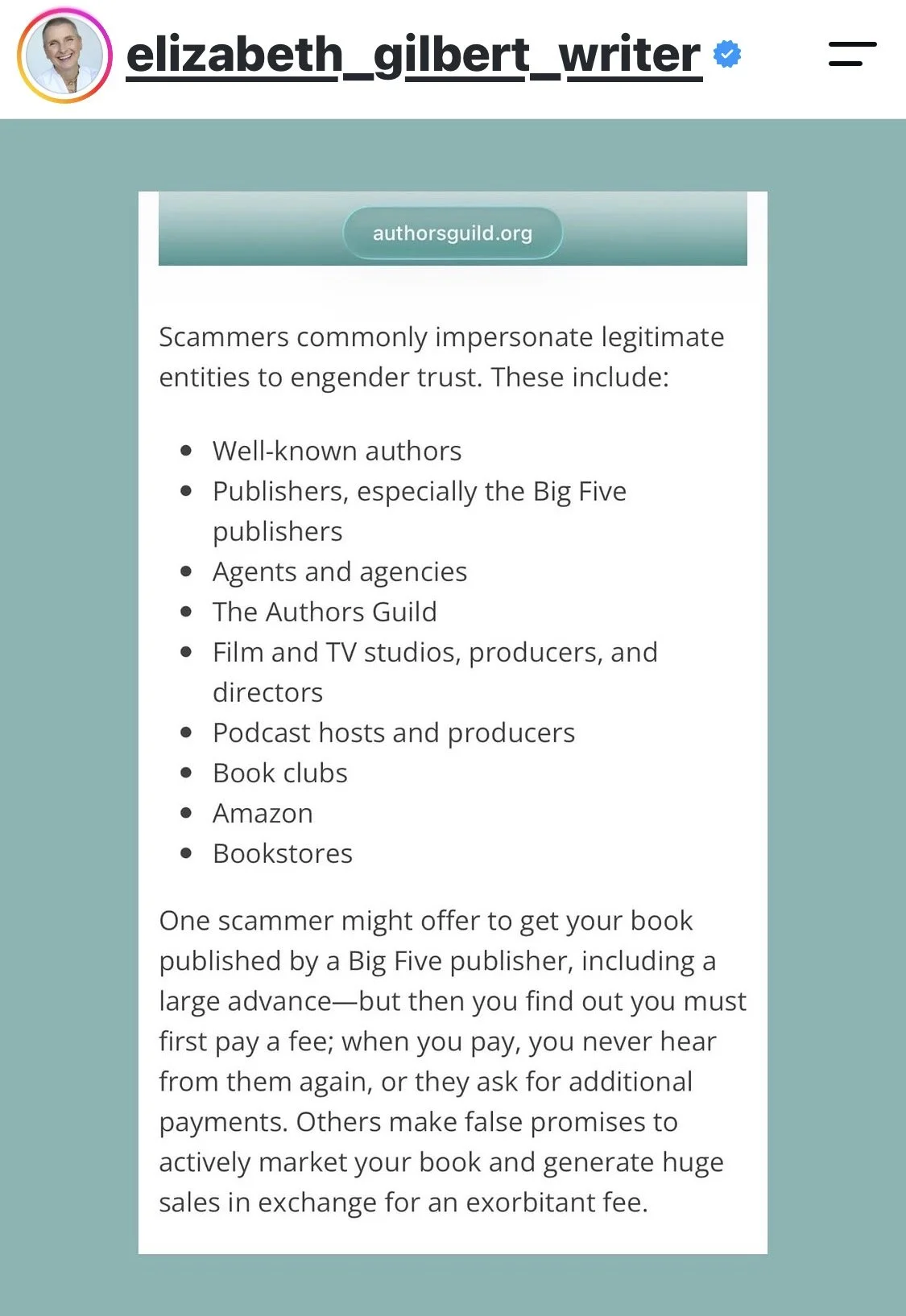
Scammers also often trick authors by pretending to be someone else–they commonly impersonate well-known authors, publishers (especially the Big Five publishers), agents and agencies, the Authors Guild, film and TV studios, producers and directors, podcast hosts and producers, book clubs, Amazon, and bookstores.
It is important–now more than ever–that authors have the skills to be able to determine what is real and what is fake.
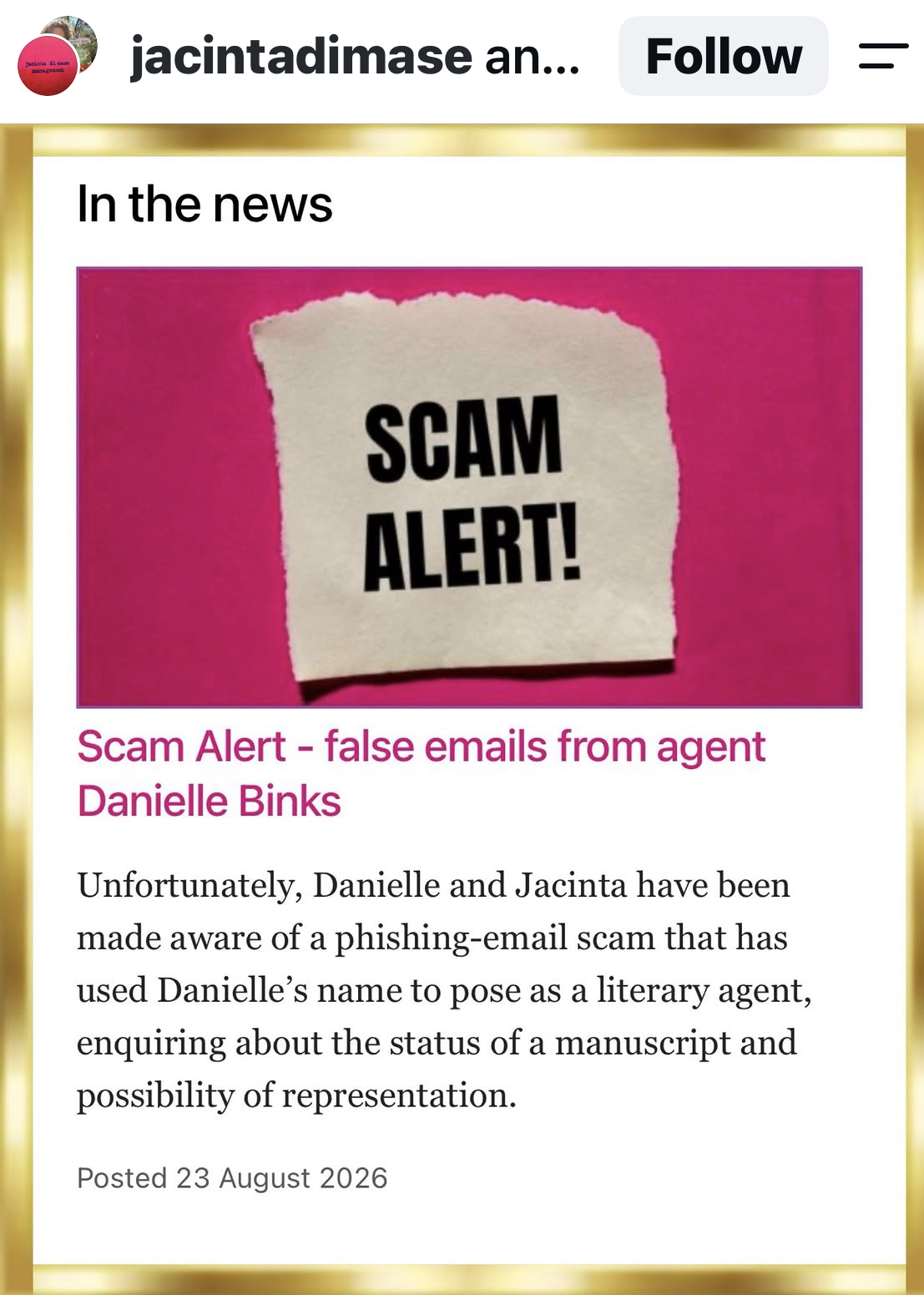
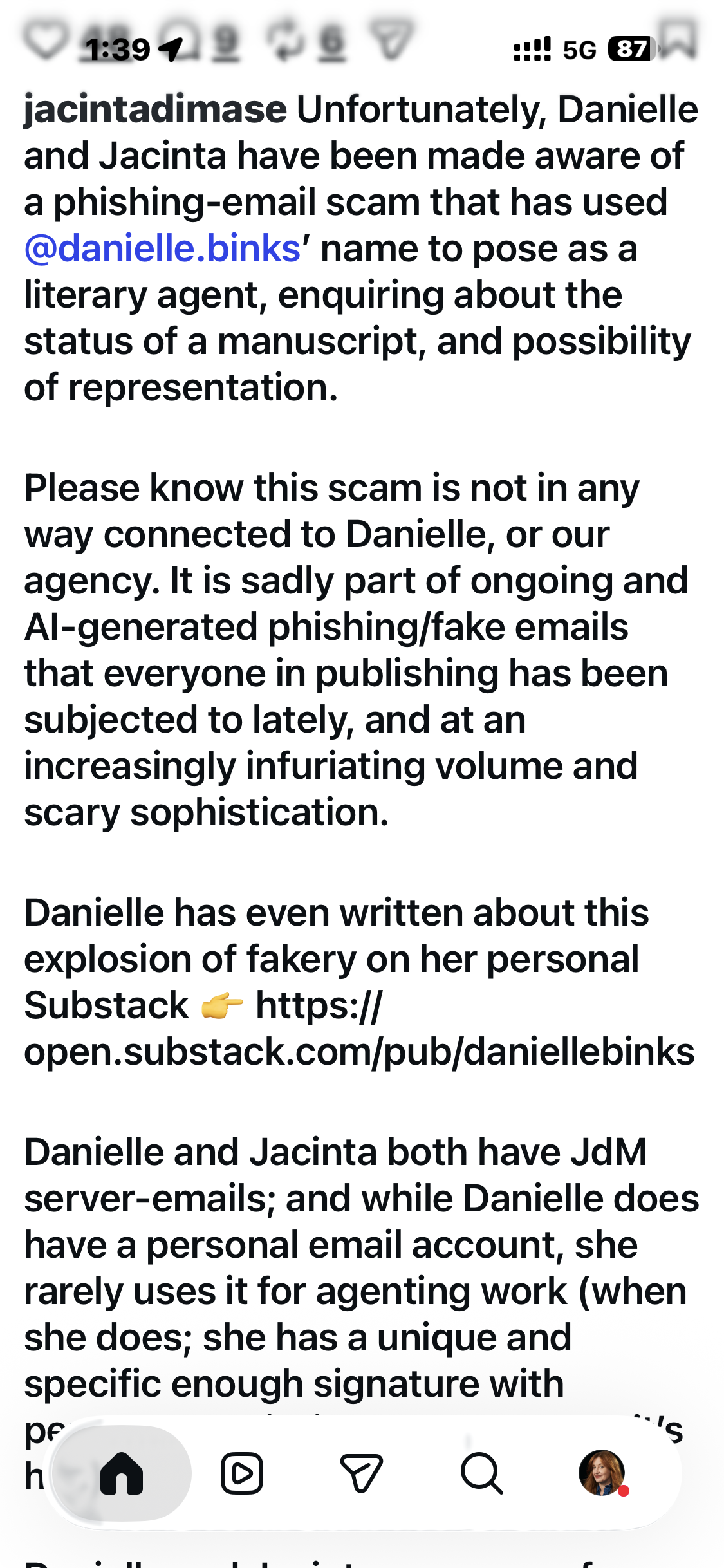
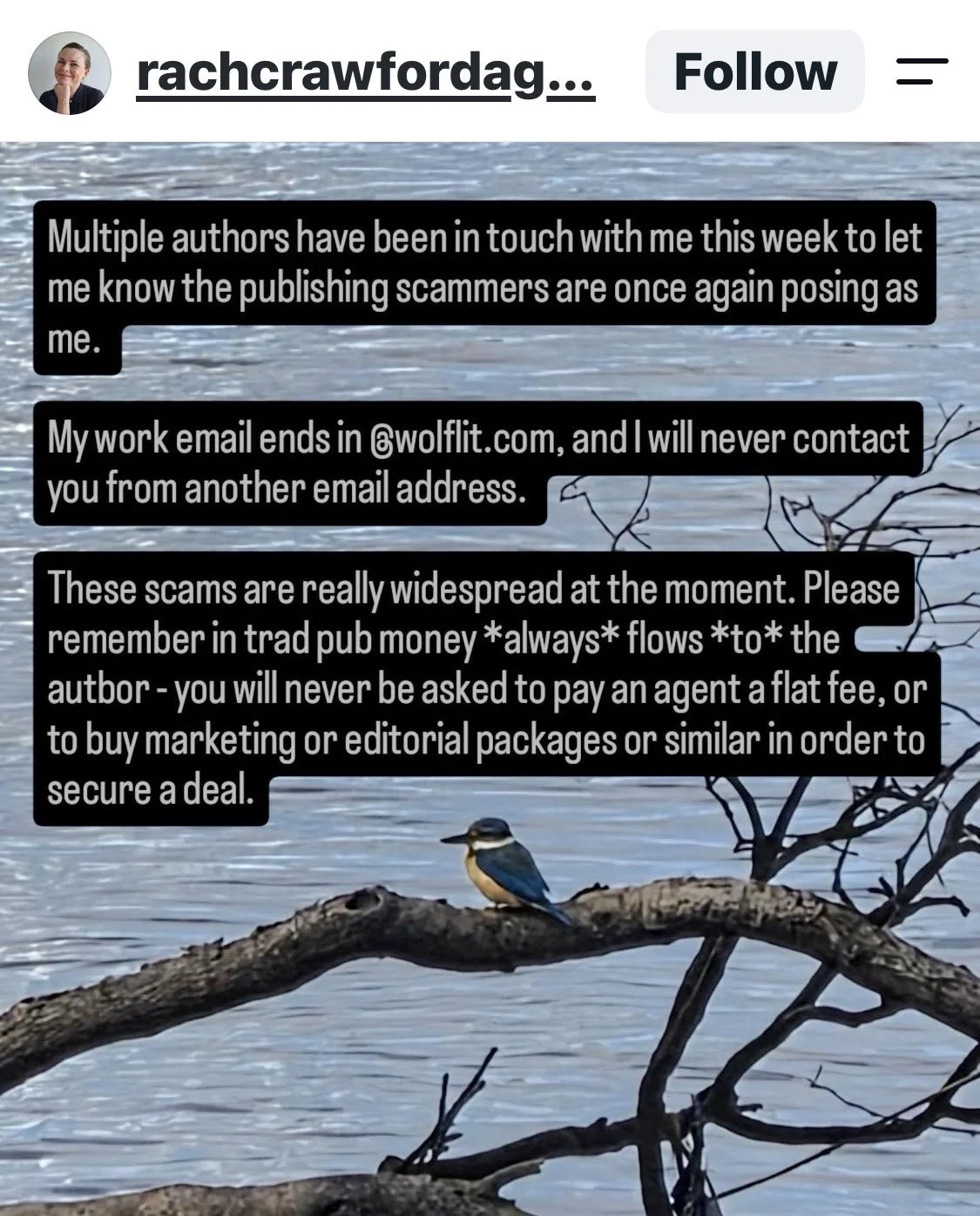
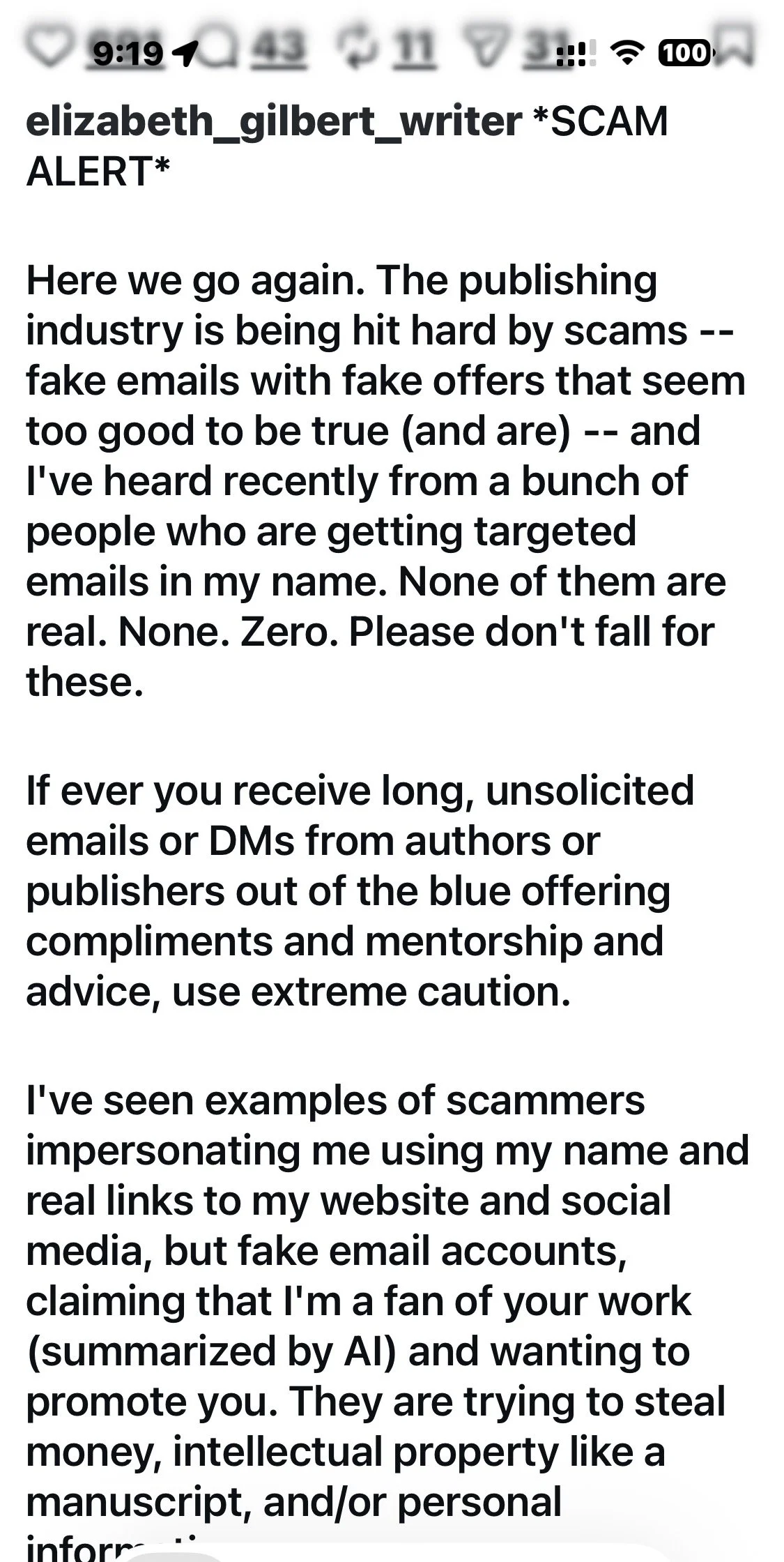
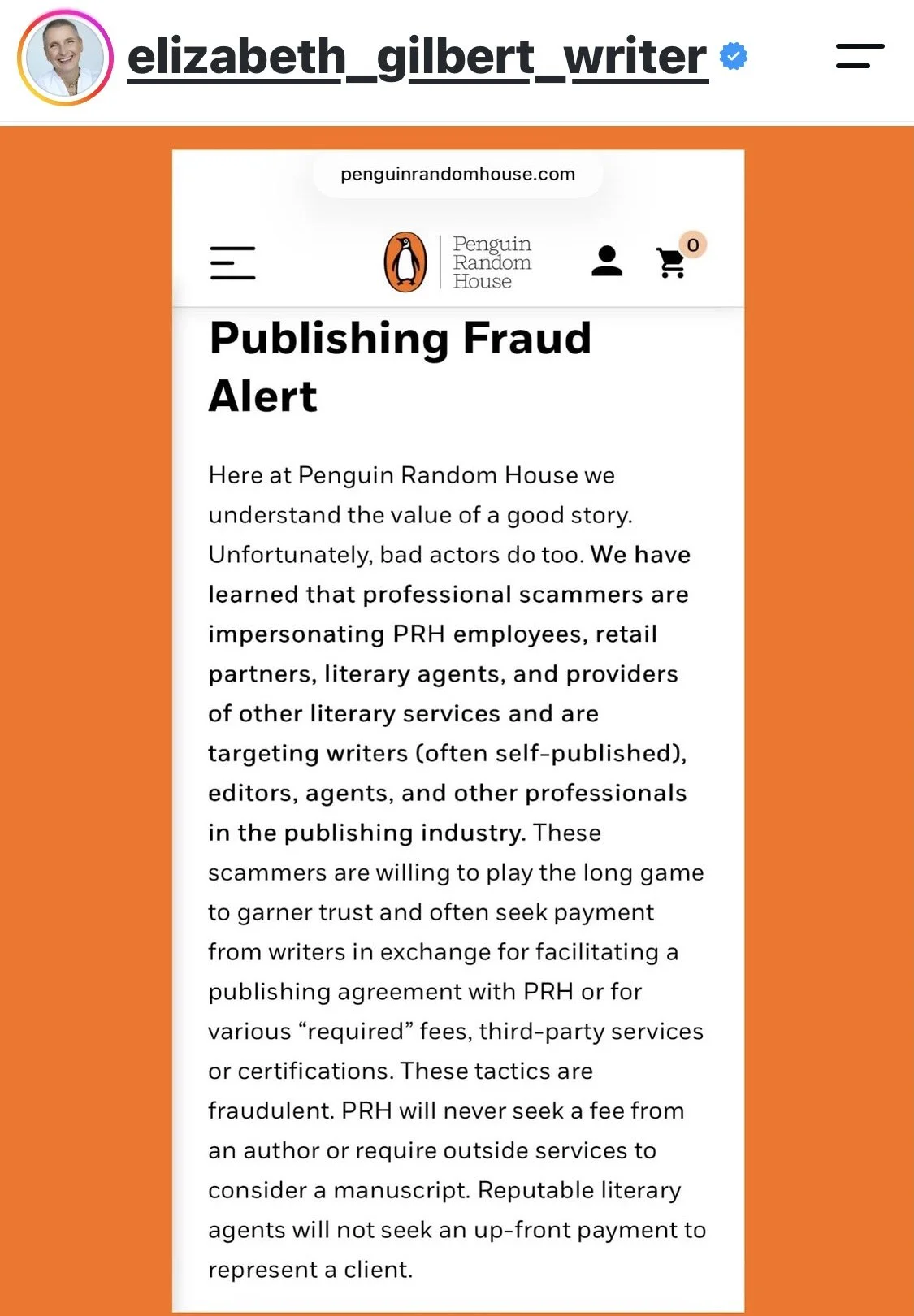
Authors are being targeted and Agents report they are being impersonated
Is It a Scam?
Below are common warning signs of scam messages to keep an eye out for.
🚩 Unsolicited or “cold” outreach.
Publishers, literary agents, directors, movie studios, etc., rarely approach authors out of the blue. Unsolicited offers are your first warning sign.
🚩 Flattery, guarantees, and exorbitant promises.
Scammers often play into authors’ emotions, promising to connect your book with an abundance of readers who will appreciate and champion your work. Scammers will make promises of guaranteed royalties or advances, paired with exorbitant fees, sometimes delivering low-impact work to continue the ruse. No legitimate publisher can guarantee bestseller status or very short-term success.
If the offer sounds too good to be true, it probably is!
🚩 Real-seeming domain names and addresses.
Fictitious domain names are designed to mimic legitimate services (e.g. macmillan.com is Macmillan’s genuine web address, while macmillanpublishing.com is a counterfeit). You can double-check whether the address/domain actually belongs to the company it claims to be by using a website you trust, rather than the contact information provided in the message.
A professional-looking e-mail address does not necessarily indicate legitimacy.
🚩 Requests for upfront fees (especially from book clubs, who do not usually require fees to review an author’s book).
Traditional publishers won’t ask for an up-front payment. On the other hand, hybrid publishers do often ask for a portion of the payment up-front, so make sure to do your research on which hybrid publishers are credible (see resources below for criteria given by the IBPA).
🚩 Requests for reading fees.
Publishers and agents don’t charge a fee to read your manuscript. Some small presses and journals can charge a small reading fee; however, if anyone is asking for a fee that seems high, do your research to ensure legitimacy.
🚩 Requests for full manuscripts or writing samples (especially from an unsolicited source).
🚩 Suspicious links.
Never click links that you are unsure of. Check for spelling mistakes within the link and names that don’t match. Ensure the link begins https:// not http://
🚩 Use of free email domains by senders claiming to represent established brands (e.g. agent-name-prh@gmail.com instead of @penguinrandomhouse.com).
🚩 Off-platform requests. Be wary of anyone asking you to take the conversation to their “private email/number” or a messaging app like WhatsApp.
🚩 Urgent and threatening communications. Never engage with these individuals and report the message to the platform where it originated.
If you have verified the legitimacy of the outreach and believe you can trust the offer, expect carefully worded agreements/contracts, especially if someone is asking for an up-front payment. The agreement should outline what tasks they will perform, when the tasks will be completed, and your ability to terminate the agreement should they fail to provide the agreed-upon deliverables. (The Authors Guild and Australian Society of Authors will review legal documents and give professional advice).
You can download antivirus software to test links and attachments, and to alert you to potential scam messages. Avast, Bitdefender, and AVG offer basic protection and are free to download.
Never reply to the message, even with “STOP”, as this only confirms the number/email is active, and will invite more scam messages. Block and report scams to the platform the message was received on. You can also report the scam to Writers Beware so they can add it to the online list.
You should also report contact from scammers directly to Scamwatch (scamwatch.gov.au) in Australia, or your national fraud authority if you're overseas — in the US, the FTC (reportfraud.ftc.gov) and the FBI's IC3 (ic3.gov).
Further Reading
Authors Guild - Publishing Scam Alerts (Known scams reported to Authors Guild)
IBPA - Hybrid Publisher Criteria (A list of criteria to ensure legitimacy for Hybrid Publishers)
Writer Beware - Impersonation List (An extensive list of warning signs of scams and a list of known scams)